
PRACTICAL GUIDE
Local SEO: 22 checks for your profile, website and reputation
A practical local SEO guide covering accurate business details, Google Business Profile, services, reviews, links and measurement without ranking promises.
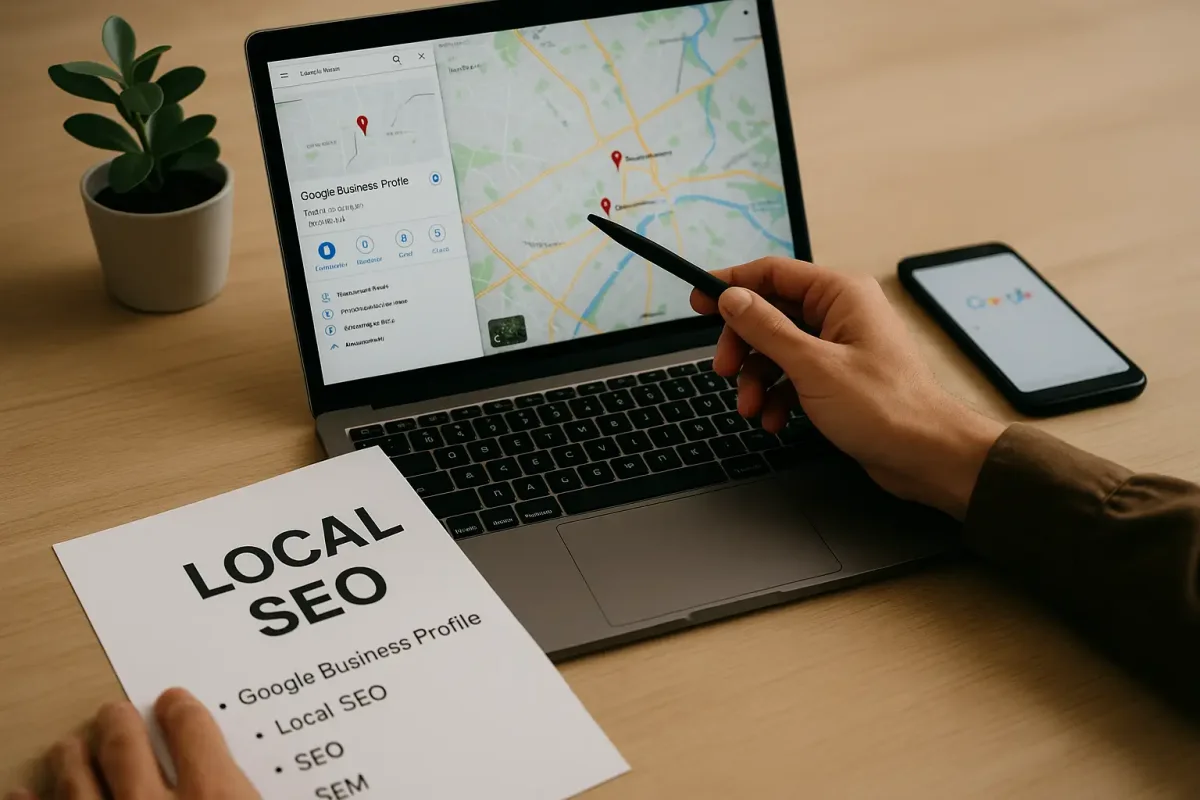
1. Local search factors
Google describes relevance, distance and prominence. Accurate information helps, but cannot remove geographical constraints or guarantee a position.
2. Primary category
Choose the closest description of your main activity. A yoga studio should not choose a broad category simply because a competitor uses it. Comparison is a research aid, not a substitute for accuracy.
3. The real business name
Use the name customers recognise on your premises and materials. Do not append cities, services or promotional phrases just for rankings. A registered company name alone does not justify misleading presentation.
4. Address and service area
Use the real address or service area appropriate to the business model. A virtual office is not a shortcut to another city. A coworking location must meet the requirements for signage, your own staff and customer reception during stated hours.
5. Additional categories
Add categories only for activities you actually provide. Complete relevant fields without inventing services to reach a completeness score.
6. Customer language
List actual services, questions from enquiries and areas served. Research tools provide search estimates that should be assessed against intent and business relevance.
7. Competitor analysis
Review organic and local results for important phrases. Tools such as Semrush can provide clues, but their estimates are not direct access to a competitor’s actual traffic.
8. Access and verification
Find the existing profile before creating another. Verification uses the methods Google offers for the particular business, which may include video. Do not assume a specific method or timeline.
9. Photographs and logo
Show the entrance, premises, team and actual service where you have publication rights. Choose clear photographs; having more images than a competitor is not a strategy in itself.
10. Services and products
Use the fields available for your profile type with specific descriptions and current terms. Do not misrepresent a service as a product purely for prominence. Feature availability depends on category and region.
11. Customer questions
Answer available customer questions and maintain FAQs on your website. Do not rely on a particular Google interface remaining unchanged; essential information should stay accessible on your own site.
12. Requesting a review
Invite honest feedback through a direct link. Do not offer rewards for posting, changing or removing a review or route only satisfied customers to public ratings. Messages must comply with applicable communication rules.
13. Negative feedback
Respond calmly without personal information and offer a way to resolve the issue. Report policy violations, not simply low ratings. Do not organise attempts to manipulate review ordering.
14. Website pages
Link the profile to the appropriate location or business page. Explain the service, contact details and terms. A separate service page is useful when content and intent differ, not for every keyword variation.
15. Directories and business details
Review relevant professional and local directories. Correct genuine differences in name, address and phone. A minor formatting variation does not necessarily identify a different business. Avoid mass submissions to arbitrary directories.
16. Editorial links
A useful local resource, professional interview or real partnership can justify a reference. Do not promise backlinks from a particular advertising budget or build excessive exchange schemes.
17. Monitoring across locations
A local rank grid can reveal differences by location. Record consistent queries, coordinates and conditions. A heatmap samples positions; it is not a count of customers or proof of what caused a change.
18. Common omissions
Check holiday hours, a working phone number, the correct address, broken links and discontinued services. These are concrete customer obstacles and deserve priority over decorative changes.
19. Inaccurate competitor profiles
Suggest edits or report concerns only with verifiable grounds. Do not use reporting to attack a competitor. Google decides whether information violates its policies and whether it should change.
20. Offers and updates
Publish genuine news and offers with accurate terms and end dates. Direct readers to a relevant page or contact route. Regular posting alone does not guarantee a higher position.
21. Maintenance and measurement
Assign responsibility for updates and replies. Separate views, website clicks, contact actions and actual enquiries. UTM parameters help identify a visit’s source but do not by themselves prove a sale.
22. A plan for the first month
Start with access, category, core information and the contact journey. Then check important pages, sources and baseline measurements. Set a manageable maintenance routine rather than quotas for reviews or directory submissions.
Frequently asked questions
Do you need a virtual address? Do not use an address that fails the real-world representation rules. How many reviews are enough? There is no universal number; seek honest feedback. Should you rename the business for SEO? Do not add keywords outside its actual identity. How often should you update? Whenever something meaningful changes, with regular accuracy checks.